 d50ec74b24
Step 5 of the planned vue->react migration. Settings is the first
entry whose state model didn't translate to the Vue-style "parent
passes a reactive object, children mutate it in place" pattern, so
the React port flips it to lifted state + a typed updateSetting
patch function.

* models/setting.ts — typed AllSetting class with the same field
  defaults and equals() behavior the vue version had. The .js
  twin is deleted; nothing else imported it.
* hooks/useAllSetting.ts — owns allSetting + oldAllSetting state,
  exposes updateSetting(patch), saveDisabled is derived via useMemo
  off equals() (no more 1Hz dirty-check timer).
* components/SettingListItem.tsx — children-based wrapper instead
  of named slots. The vue twin stays alive because xray (BasicsTab,
  DnsTab) still imports it; deleted when xray migrates.

The five tab components and the TwoFactorModal each accept
{ allSetting, updateSetting } and render with AntD v5's Collapse
items[] API. Every v-model:value="x" became
value={...} onChange={(e) => updateSetting({ key: e.target.value })}
or onChange={(v) => updateSetting({ key: v })} for non-input
controls.

SubscriptionFormatsTab is the trickiest — fragment / noises[] /
mux / direct routing rules are stored as JSON-encoded strings on
the wire. Parsing them once via useMemo per field, mutating the
parsed object on edit, and stringifying back into the patch keeps
the round-trip identical to the vue version.

SettingsPage hosts the tab navigation (with hash sync), the
save / restart action bar, the security-warnings alert banner,
and the restart flow that rebuilds the panel URL after the new
host/port/cert settings take effect.
|
||
|---|---|---|
| .github | ||
| .vscode | ||
| config | ||
| database | ||
| frontend | ||
| logger | ||
| media | ||
| sub | ||
| util | ||
| web | ||
| windows_files | ||
| xray | ||
| .env.example | ||
| .gitignore | ||
| .nvmrc | ||
| CONTRIBUTING.md | ||
| docker-compose.yml | ||
| DockerEntrypoint.sh | ||
| Dockerfile | ||
| DockerInit.sh | ||
| go.mod | ||
| go.sum | ||
| install.sh | ||
| LICENSE | ||
| main.go | ||
| README.ar_EG.md | ||
| README.es_ES.md | ||
| README.fa_IR.md | ||
| README.md | ||
| README.ru_RU.md | ||
| README.zh_CN.md | ||
| update.sh | ||
| x-ui.rc | ||
| x-ui.service.arch | ||
| x-ui.service.debian | ||
| x-ui.service.rhel | ||
| x-ui.sh | ||
English | فارسی | العربية | 中文 | Español | Русский





3X-UI — advanced, open-source web-based control panel designed for managing Xray-core server. It offers a user-friendly interface for configuring and monitoring various VPN and proxy protocols.
Important
This project is only for personal usage, please do not use it for illegal purposes, and please do not use it in a production environment.
As an enhanced fork of the original X-UI project, 3X-UI provides improved stability, broader protocol support, and additional features.
Quick Start
bash <(curl -Ls https://raw.githubusercontent.com/mhsanaei/3x-ui/master/install.sh)
For full documentation, please visit the project Wiki.
Database Options
3X-UI supports two backends, chosen during the install:
- SQLite (default) — a single file at
/etc/x-ui/x-ui.db. Zero setup, ideal for small/medium deployments. - PostgreSQL — recommended for high client counts or multi-node setups. The installer can install PostgreSQL locally for you, or accept a DSN to an existing server.
At runtime the backend is selected via env vars (the installer writes these to /etc/default/x-ui for you):
XUI_DB_TYPE=postgres
XUI_DB_DSN=postgres://xui:password@127.0.0.1:5432/xui?sslmode=disable
Migrating an existing SQLite install to PostgreSQL
x-ui migrate-db --dsn "postgres://xui:password@127.0.0.1:5432/xui?sslmode=disable"
# then set XUI_DB_TYPE and XUI_DB_DSN in /etc/default/x-ui and restart:
systemctl restart x-ui
The source SQLite file is left untouched; remove it manually once you have verified the new backend.
Docker
The default docker compose up -d keeps using SQLite. To run with the bundled PostgreSQL service, uncomment the two XUI_DB_* env lines in docker-compose.yml and start with the profile:
docker compose --profile postgres up -d
A Special Thanks to
Acknowledgment
- Iran v2ray rules (License: GPL-3.0): Enhanced v2ray/xray and v2ray/xray-clients routing rules with built-in Iranian domains and a focus on security and adblocking.
- Russia v2ray rules (License: GPL-3.0): This repository contains automatically updated V2Ray routing rules based on data on blocked domains and addresses in Russia.
Community Tools
Tools and integrations built by the community around 3x-ui.
- terraform-provider-3x-ui (License: MIT): Manage inbounds, clients, panel settings, and Xray configuration as code with Terraform / OpenTofu.
Support project
If this project is helpful to you, you may wish to give it a🌟


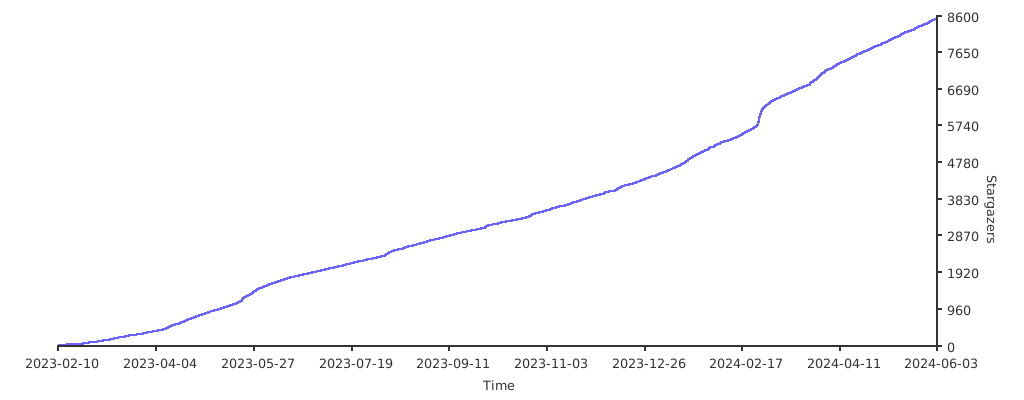
Stargazers over Time