 3213d62750
Two related gaps on the Hysteria side of the subscription layer:

1) `genHysteriaLink` ignored `externalProxy` entirely, so an admin who
   pointed a Hysteria inbound at an alternate endpoint (e.g. a CDN
   hostname forwarding UDP back to the node) still got a link with the
   original server address. Mirror what `genVlessLink` / `genTrojanLink`
   already do: fan out one link per entry, substituting `dest` / `port`
   and picking up the entry's remark suffix. As a bonus, the salamander
   obfs password is now copied into the URL too — the panel-side link
   generator already did this, so the subscription output was lagging
   behind it.

2) `buildProxy` in `subClashService.go` had a protocol switch with cases
   for VMESS / VLESS / Trojan / Shadowsocks and a `default: return nil`.
   Hysteria inbounds fell into the default branch and silently vanished
   from the Clash YAML. Route Hysteria to a dedicated
   `buildHysteriaProxy` helper before the transport/security helpers run
   (applyTransport / applySecurity model xray streams, which Hysteria
   doesn't use).

   `buildHysteriaProxy` reads `inbound.StreamSettings` directly instead
   of going through `streamData` / `tlsData`, because those prune
   fields (`allowInsecure`, the salamander `finalmask.udp` block) that
   the mihomo Hysteria proxy wants preserved. Output shape matches
   mihomo's expectations:

     type: hysteria2                  # or "hysteria" for v1
     password / auth-str: <client auth>
     sni, alpn, skip-cert-verify, client-fingerprint
     obfs: salamander
     obfs-password: <finalmask.udp[salamander].settings.password>

The existing `getProxies` fanout over `externalProxy` already plugs in
for Clash, so with Hysteria now recognised, External Proxy entries
also flow through to the Clash output for Hysteria inbounds.

Closes #4053
|
||
|---|---|---|
| .github | ||
| .vscode | ||
| config | ||
| database | ||
| logger | ||
| media | ||
| sub | ||
| util | ||
| web | ||
| windows_files | ||
| xray | ||
| .env.example | ||
| .gitignore | ||
| CONTRIBUTING.md | ||
| docker-compose.yml | ||
| DockerEntrypoint.sh | ||
| Dockerfile | ||
| DockerInit.sh | ||
| go.mod | ||
| go.sum | ||
| install.sh | ||
| LICENSE | ||
| main.go | ||
| README.ar_EG.md | ||
| README.es_ES.md | ||
| README.fa_IR.md | ||
| README.md | ||
| README.ru_RU.md | ||
| README.zh_CN.md | ||
| update.sh | ||
| x-ui.rc | ||
| x-ui.service.arch | ||
| x-ui.service.debian | ||
| x-ui.service.rhel | ||
| x-ui.sh | ||
English | فارسی | العربية | 中文 | Español | Русский





3X-UI — advanced, open-source web-based control panel designed for managing Xray-core server. It offers a user-friendly interface for configuring and monitoring various VPN and proxy protocols.
Important
This project is only for personal usage, please do not use it for illegal purposes, and please do not use it in a production environment.
As an enhanced fork of the original X-UI project, 3X-UI provides improved stability, broader protocol support, and additional features.
Custom GeoSite / GeoIP DAT sources
Administrators can add custom GeoSite and GeoIP .dat files from URLs in the panel (same workflow as updating built-in geofiles). Files are stored under the same directory as the Xray binary (XUI_BIN_FOLDER, default bin/) with deterministic names: geosite_<alias>.dat and geoip_<alias>.dat.
Routing: Xray resolves extra lists using the ext: form, for example ext:geosite_myalias.dat:tag or ext:geoip_myalias.dat:tag, where tag is a list name inside that DAT file (same pattern as built-in regional files such as ext:geoip_IR.dat:ir).
Reserved aliases: Only for deciding whether a name is reserved, the panel compares a normalized form of the alias (strings.ToLower, - → _). User-entered aliases and generated file names are not rewritten in the database; they must still match ^[a-z0-9_-]+$. For example, geoip-ir and geoip_ir collide with the same reserved entry.
Quick Start
bash <(curl -Ls https://raw.githubusercontent.com/mhsanaei/3x-ui/master/install.sh)
For full documentation, please visit the project Wiki.
A Special Thanks to
Acknowledgment
- Iran v2ray rules (License: GPL-3.0): Enhanced v2ray/xray and v2ray/xray-clients routing rules with built-in Iranian domains and a focus on security and adblocking.
- Russia v2ray rules (License: GPL-3.0): This repository contains automatically updated V2Ray routing rules based on data on blocked domains and addresses in Russia.
Support project
If this project is helpful to you, you may wish to give it a🌟


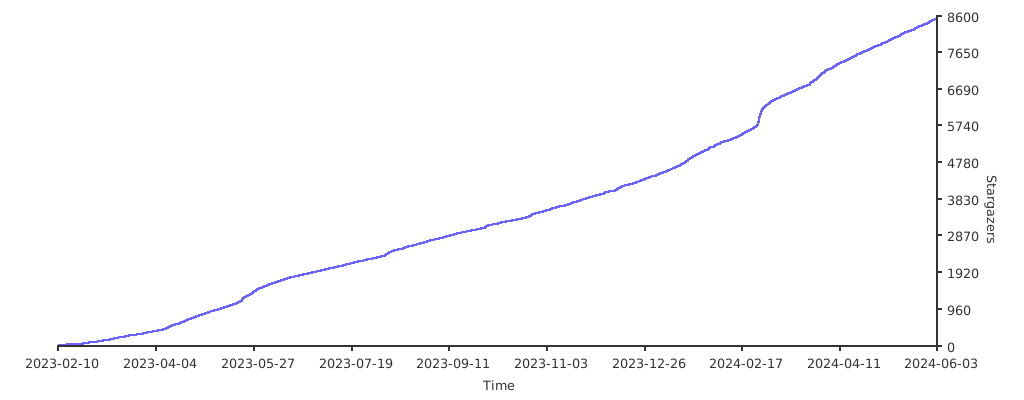
Stargazers over Time