 2983ac3f8e
* Fix: propagate xhttp xPadding settings into generated subscription links

The four `genXLink` helpers in `sub/subService.go` only copied `path`,
`host` and `mode` out of `xhttpSettings` when building vmess:// /
vless:// / trojan:// / ss:// URLs. Everything else — `xPaddingBytes`,
`xPaddingObfsMode`, `xPaddingKey`, `xPaddingHeader`,
`xPaddingPlacement`, `xPaddingMethod` — was silently dropped.

That meant an admin who set, say, `xPaddingBytes: "80-600"` plus obfs
mode with a custom `xPaddingKey` on the inbound had a server config
that no client could match from the copy-pasted link: the client kept
the xray/sing-box internal defaults (`100-1000`, `x_padding`,
`Referer`), hit the server, and was rejected by

    invalid padding (queryInHeader=Referer, key=x_padding) length: 0

The user-visible symptom on OpenWRT / Podkop / sing-box was
"xhttp inbound just won't connect" — no obvious pointer to what was
actually wrong because the link itself *looks* complete.

Fix:

  * New helper `applyXhttpPaddingParams(xhttp, params)` writes
    `x_padding_bytes=<range>` (flat, sing-box family reads this) and
    an `extra=<url-encoded-json>` blob carrying the full set of xhttp
    settings (xray-core family reads this). Both encodings are emitted
    side-by-side so every mainstream client can pick at least one up.
  * All four link generators (`genVmessLink` via the obj map,
    `genVlessLink`, `genTrojanLink`, `genShadowsocksLink`) now invoke
    the copy.
  * Obfs-only fields (`xPaddingKey`, `xPaddingHeader`,
    `xPaddingPlacement`, `xPaddingMethod`) are only included when
    `xPaddingObfsMode` is actually true and the admin filled them in.
    An inbound with no custom padding produces exactly the same URL
    as before — existing subscriptions are unaffected.

* Also propagate xhttp xPadding settings into the panel's own Info/QR links

The previous commit covered the subscription service
(sub/subService.go). The admin-panel side — the "Copy URL" / QR /
Info buttons inside inbound details — has four more
xhttp-emitting link generators in `web/assets/js/model/inbound.js`
(`genVmessLink`, `genVLESSLink`, `genTrojanLink`, `genSSLink`) that
had the exact same gap: only `path`, `host` and `mode` were copied.

Mirror the server-side fix on the client:

* Add two static helpers on `Inbound`:
  - `Inbound.applyXhttpPaddingToParams(xhttp, params)` for
    `vless://` / `trojan://` / `ss://` style URLs — writes
    `x_padding_bytes=<range>` (sing-box family) and
    `extra=<url-encoded-json>` (xray-core family).
  - `Inbound.applyXhttpPaddingToObj(xhttp, obj)` for the VMess base64
    JSON body — sets the same fields directly on the object.
* Call them from all four link generators so an admin who enables
  obfs mode + a custom `xPaddingKey` / `xPaddingHeader` actually
  gets a working URL from the panel.
* Only non-empty fields are emitted, so default inbounds produce
  exactly the same URL as before.

Also fixes a latent positional-args bug in
`web/assets/js/model/outbound.js`: both VMess-JSON (L933) and
`fromParamLink` (L975) were calling
`new xHTTPStreamSettings(path, host, mode)` — but the 3rd positional
arg of the constructor is `headers`, not `mode`, so `mode` was
landing in the `headers` slot and the actual `mode` field stayed at
its default. Construct explicitly and set `mode` by name; while
here, also pick up `x_padding_bytes` and the `extra` JSON blob from
the imported URL so the symmetric case of importing a padded link
works too.

---------

Co-authored-by: pwnnex <eternxles@gmail.com>
|
||
|---|---|---|
| .github | ||
| .vscode | ||
| config | ||
| database | ||
| logger | ||
| media | ||
| sub | ||
| util | ||
| web | ||
| windows_files | ||
| xray | ||
| .env.example | ||
| .gitignore | ||
| CONTRIBUTING.md | ||
| docker-compose.yml | ||
| DockerEntrypoint.sh | ||
| Dockerfile | ||
| DockerInit.sh | ||
| go.mod | ||
| go.sum | ||
| install.sh | ||
| LICENSE | ||
| main.go | ||
| README.ar_EG.md | ||
| README.es_ES.md | ||
| README.fa_IR.md | ||
| README.md | ||
| README.ru_RU.md | ||
| README.zh_CN.md | ||
| update.sh | ||
| x-ui.rc | ||
| x-ui.service.arch | ||
| x-ui.service.debian | ||
| x-ui.service.rhel | ||
| x-ui.sh | ||
English | فارسی | العربية | 中文 | Español | Русский





3X-UI — advanced, open-source web-based control panel designed for managing Xray-core server. It offers a user-friendly interface for configuring and monitoring various VPN and proxy protocols.
Important
This project is only for personal usage, please do not use it for illegal purposes, and please do not use it in a production environment.
As an enhanced fork of the original X-UI project, 3X-UI provides improved stability, broader protocol support, and additional features.
Custom GeoSite / GeoIP DAT sources
Administrators can add custom GeoSite and GeoIP .dat files from URLs in the panel (same workflow as updating built-in geofiles). Files are stored under the same directory as the Xray binary (XUI_BIN_FOLDER, default bin/) with deterministic names: geosite_<alias>.dat and geoip_<alias>.dat.
Routing: Xray resolves extra lists using the ext: form, for example ext:geosite_myalias.dat:tag or ext:geoip_myalias.dat:tag, where tag is a list name inside that DAT file (same pattern as built-in regional files such as ext:geoip_IR.dat:ir).
Reserved aliases: Only for deciding whether a name is reserved, the panel compares a normalized form of the alias (strings.ToLower, - → _). User-entered aliases and generated file names are not rewritten in the database; they must still match ^[a-z0-9_-]+$. For example, geoip-ir and geoip_ir collide with the same reserved entry.
Quick Start
bash <(curl -Ls https://raw.githubusercontent.com/mhsanaei/3x-ui/master/install.sh)
For full documentation, please visit the project Wiki.
A Special Thanks to
Acknowledgment
- Iran v2ray rules (License: GPL-3.0): Enhanced v2ray/xray and v2ray/xray-clients routing rules with built-in Iranian domains and a focus on security and adblocking.
- Russia v2ray rules (License: GPL-3.0): This repository contains automatically updated V2Ray routing rules based on data on blocked domains and addresses in Russia.
Support project
If this project is helpful to you, you may wish to give it a🌟


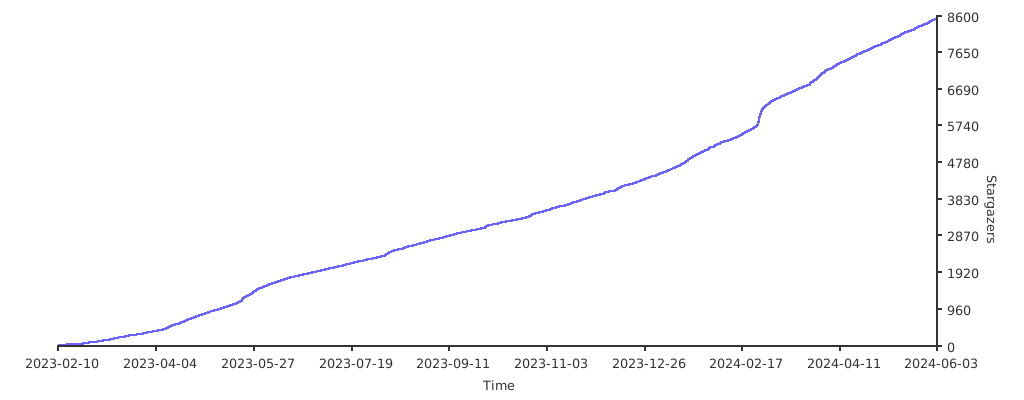
Stargazers over Time