22e88ec4eb
Step 4 of the planned vue->react migration. The nodes entry brings in
the largest shared-infrastructure batch so far — every authenticated
react page from here on can lean on these.

New shared pieces (live alongside their .vue counterparts during
coexistence):

* hooks/useMediaQuery.ts — useState + resize listener
* hooks/useWebSocket.ts — wraps WebSocketClient, subscribes on mount
  and unsubscribes on unmount. The underlying client is a single
  module-level instance so multiple components on the same page
  share one socket.
* hooks/useNodes.ts — node list state + CRUD + probe/test, including
  the totals memo (online/offline/avgLatency) used by the summary card.
  applyNodesEvent is the entry point for the heartbeat-pushed list.
* components/CustomStatistic.tsx — thin Statistic wrapper, prefix +
  suffix slots become props.
* components/Sparkline.tsx — the SVG line chart with measured-width
  axis scaling, gradient fill, tooltip overlay, and per-instance
  gradient id from React.useId. ResizeObserver lifecycle is in
  useEffect; the math is unchanged.

Pages:

* NodesPage — wires hooks + WebSocket together, renders summary card
  + NodeList, hosts the form modal. Uses Modal.useModal() for the
  delete confirm so the dialog inherits ConfigProvider theming.
* NodeList — desktop renders a Table with expandable history rows;
  mobile flips to a vertical card list whose actions live in a
  bottom-right Dropdown. The IP-blur eye toggle persists across both.
* NodeFormModal — controlled form (useState object, single setForm
  per change). The reset-on-open effect computes the next state
  once and applies it with eslint-disable to satisfy the new
  react-hooks/set-state-in-effect rule on a legitimate pattern.
* NodeHistoryPanel — polls /panel/api/nodes/history/{id}/{metric}/
  {bucket} every 15s, renders cpu+mem sparklines side-by-side.
|
||
|---|---|---|
| .github | ||
| .vscode | ||
| config | ||
| database | ||
| frontend | ||
| logger | ||
| media | ||
| sub | ||
| util | ||
| web | ||
| windows_files | ||
| xray | ||
| .env.example | ||
| .gitignore | ||
| .nvmrc | ||
| CONTRIBUTING.md | ||
| docker-compose.yml | ||
| DockerEntrypoint.sh | ||
| Dockerfile | ||
| DockerInit.sh | ||
| go.mod | ||
| go.sum | ||
| install.sh | ||
| LICENSE | ||
| main.go | ||
| README.ar_EG.md | ||
| README.es_ES.md | ||
| README.fa_IR.md | ||
| README.md | ||
| README.ru_RU.md | ||
| README.zh_CN.md | ||
| update.sh | ||
| x-ui.rc | ||
| x-ui.service.arch | ||
| x-ui.service.debian | ||
| x-ui.service.rhel | ||
| x-ui.sh | ||
English | فارسی | العربية | 中文 | Español | Русский





3X-UI — advanced, open-source web-based control panel designed for managing Xray-core server. It offers a user-friendly interface for configuring and monitoring various VPN and proxy protocols.
Important
This project is only for personal usage, please do not use it for illegal purposes, and please do not use it in a production environment.
As an enhanced fork of the original X-UI project, 3X-UI provides improved stability, broader protocol support, and additional features.
Quick Start
bash <(curl -Ls https://raw.githubusercontent.com/mhsanaei/3x-ui/master/install.sh)
For full documentation, please visit the project Wiki.
Database Options
3X-UI supports two backends, chosen during the install:
- SQLite (default) — a single file at
/etc/x-ui/x-ui.db. Zero setup, ideal for small/medium deployments. - PostgreSQL — recommended for high client counts or multi-node setups. The installer can install PostgreSQL locally for you, or accept a DSN to an existing server.
At runtime the backend is selected via env vars (the installer writes these to /etc/default/x-ui for you):
XUI_DB_TYPE=postgres
XUI_DB_DSN=postgres://xui:password@127.0.0.1:5432/xui?sslmode=disable
Migrating an existing SQLite install to PostgreSQL
x-ui migrate-db --dsn "postgres://xui:password@127.0.0.1:5432/xui?sslmode=disable"
# then set XUI_DB_TYPE and XUI_DB_DSN in /etc/default/x-ui and restart:
systemctl restart x-ui
The source SQLite file is left untouched; remove it manually once you have verified the new backend.
Docker
The default docker compose up -d keeps using SQLite. To run with the bundled PostgreSQL service, uncomment the two XUI_DB_* env lines in docker-compose.yml and start with the profile:
docker compose --profile postgres up -d
A Special Thanks to
Acknowledgment
- Iran v2ray rules (License: GPL-3.0): Enhanced v2ray/xray and v2ray/xray-clients routing rules with built-in Iranian domains and a focus on security and adblocking.
- Russia v2ray rules (License: GPL-3.0): This repository contains automatically updated V2Ray routing rules based on data on blocked domains and addresses in Russia.
Community Tools
Tools and integrations built by the community around 3x-ui.
- terraform-provider-3x-ui (License: MIT): Manage inbounds, clients, panel settings, and Xray configuration as code with Terraform / OpenTofu.
Support project
If this project is helpful to you, you may wish to give it a🌟


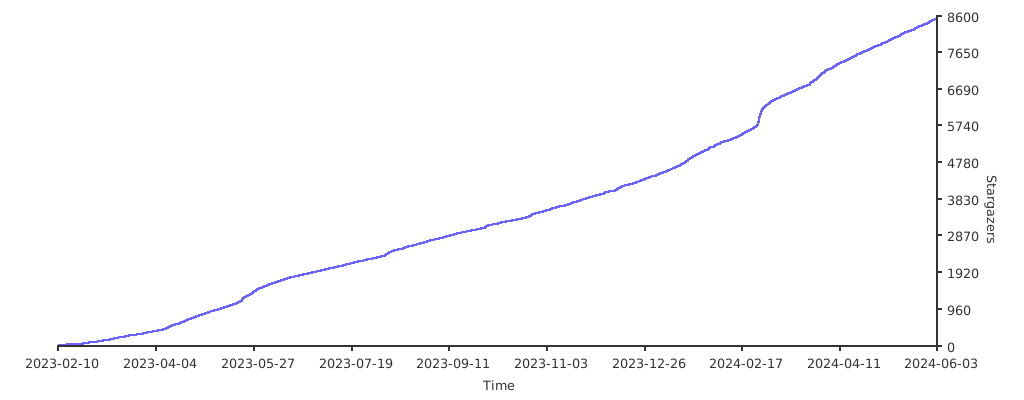
Stargazers over Time