mirror of
https://github.com/MHSanaei/3x-ui.git
synced 2026-06-06 13:14:11 +00:00
Xray panel supporting multi-protocol multi-user expire day & traffic & ip limit (Vmess & Vless & Trojan & ShadowSocks & Wireguard)
dokodemo-doorfail2banhttprealityshadowsocksshadowsocks2022socks5trojanutlsvlessvmesswireguardxtlsxtls-rprx-visionxtls-rprx-vision-udp443
 18658b7eaa
The Vue SPA had been reading from frontend/src/locales/*.json while the Go binary still loaded web/translation/translate.*.toml — and a sync-locales.mjs pre-build step kept the two in lockstep, with TOML as the source of truth. Now that go-i18n v2.6.1 already flattens nested JSON via recGetMessages/addChildMessages, both runtimes can share one file per locale. - Move the 13 nested-JSON locale files to web/translation/<lang>.json so they live alongside the Go //go:embed translation/* directive. - Switch web/locale/locale.go from toml.Unmarshal to json.Unmarshal (and drop the pelletier/go-toml import — it's now indirect-only). Confirmed via a smoke test that pages.index.cpu, subscription.title, tgbot.commands.help, and menu.settings all resolve in en-US, fa-IR, ru-RU, and zh-CN. - Repoint Vue's i18n loader at the new path (../../../web/translation/ *.json glob) and drop the moved-here pathDelimiter comment that no longer applies. - Delete the 13 legacy translate.*.toml files and the sync-locales.mjs script + its npm pre-script hooks (predev/prebuild/i18n:sync). The Telegram bot and subscription page still get their messages because they were reading the same MessageIDs the JSON files now produce. - Update copilot-instructions.md so the next contributor knows where the canonical translation files live. Co-Authored-By: Claude Opus 4.7 <noreply@anthropic.com> |
||
|---|---|---|
| .github | ||
| .vscode | ||
| config | ||
| database | ||
| docs/migrations | ||
| frontend | ||
| logger | ||
| media | ||
| sub | ||
| util | ||
| web | ||
| windows_files | ||
| xray | ||
| .env.example | ||
| .gitignore | ||
| CONTRIBUTING.md | ||
| docker-compose.yml | ||
| DockerEntrypoint.sh | ||
| Dockerfile | ||
| DockerInit.sh | ||
| go.mod | ||
| go.sum | ||
| install.sh | ||
| LICENSE | ||
| main.go | ||
| README.ar_EG.md | ||
| README.es_ES.md | ||
| README.fa_IR.md | ||
| README.md | ||
| README.ru_RU.md | ||
| README.zh_CN.md | ||
| update.sh | ||
| x-ui.rc | ||
| x-ui.service.arch | ||
| x-ui.service.debian | ||
| x-ui.service.rhel | ||
| x-ui.sh | ||
English | فارسی | العربية | 中文 | Español | Русский





3X-UI — advanced, open-source web-based control panel designed for managing Xray-core server. It offers a user-friendly interface for configuring and monitoring various VPN and proxy protocols.
Important
This project is only for personal usage, please do not use it for illegal purposes, and please do not use it in a production environment.
As an enhanced fork of the original X-UI project, 3X-UI provides improved stability, broader protocol support, and additional features.
Quick Start
bash <(curl -Ls https://raw.githubusercontent.com/mhsanaei/3x-ui/master/install.sh)
For full documentation, please visit the project Wiki.
A Special Thanks to
Acknowledgment
- Iran v2ray rules (License: GPL-3.0): Enhanced v2ray/xray and v2ray/xray-clients routing rules with built-in Iranian domains and a focus on security and adblocking.
- Russia v2ray rules (License: GPL-3.0): This repository contains automatically updated V2Ray routing rules based on data on blocked domains and addresses in Russia.
Support project
If this project is helpful to you, you may wish to give it a🌟


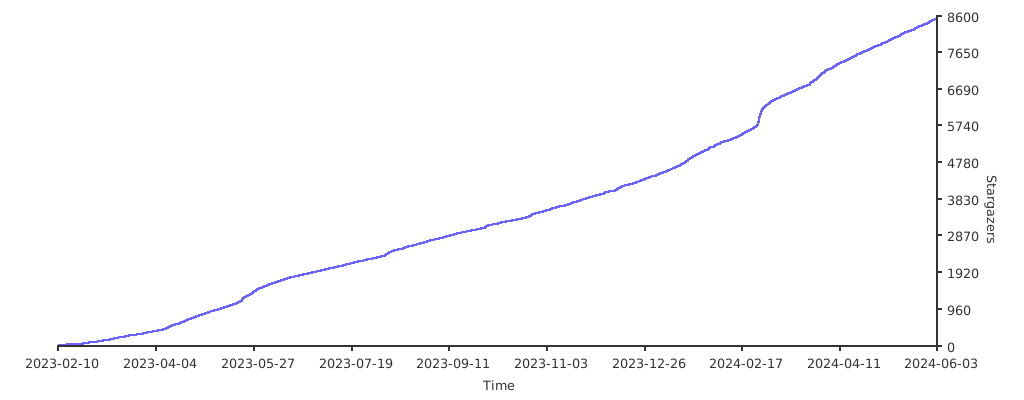
Stargazers over Time