072d266f50
Bulk add/delete were serial on the frontend (one toast per call, N round-trips)
and the backend race exposed by parallelizing them lost client attachments and
hit UNIQUE constraint failed on client_inbounds. The single add/edit modal also
had no Start-After-First-Use option, and the table never showed the delayed
duration.

Backend (web/service/client.go):
- Per-inbound mutex on Add/Update/Del InboundClient so concurrent writers on
  the same inbound don't lose the read-modify-write of settings JSON.
- SyncInbound skips create+join when the email is tombstoned so a concurrent
  maintenance pass (adjustTraffics, autoRenewClients, markClientsDisabledIn-
  Settings) that did a stale RMW can't resurrect a just-deleted client with a
  fresh id.
- compactOrphans sweeps settings.clients entries whose ClientRecord no longer
  exists, applied in Add/DelInboundClient + DelInboundClientByEmail so each
  user-initiated mutation self-heals the inbound's settings.
- DelInboundClient uses Pluck instead of First for the stats lookup so a
  missing row doesn't abort the delete with a noisy ErrRecordNotFound log.

Frontend:
- HttpUtil.{get,post} accept a silent option that suppresses the auto-toast.
- ClientBulkAddModal fires creates in parallel + silent + one summary toast.
- useClients.removeMany runs deletes in parallel + silent and refreshes once;
  ClientsPage bulk delete uses it and shows one aggregate toast.
- useClients.applyInvalidate debounces 200 ms so the burst of N WebSocket
  invalidate events from the backend collapses into a single refresh.
- ClientsPage pagination is reactive (paginationState ref + tablePagination
  computed); onTableChange persists page-size and page changes.
- ClientFormModal gains a Start-After-First-Use switch + Duration days input
  alongside the existing Expiry Date picker; on edit-mode open a negative
  expiryTime is decoded back to delayed mode + days; on submit the payload
  sends -86400000 * days or the absolute timestamp.
- ClientsPage table shows the delayed-start duration (blue tag Nd, tooltip
  Start After First Use: Nd) instead of infinity.
- Telegram ID field in the form is hidden when /panel/setting/defaultSettings
  reports tgBotEnable=false; Comment then fills the row.
- Form row 3 collapses UUID (span 12) + Total GB (span 8) + Limit IP (span 4)
  when ipLimitEnable is on, else UUID + Total GB at 12/12.
- useInbounds.rollupClients counts only clients with a matching clientStats
  row, so orphans in settings.clients no longer inflate the inbound's count.

Co-Authored-By: Claude Opus 4.7 <noreply@anthropic.com>
|
||
|---|---|---|
| .github | ||
| .vscode | ||
| config | ||
| database | ||
| frontend | ||
| logger | ||
| media | ||
| sub | ||
| util | ||
| web | ||
| windows_files | ||
| xray | ||
| .env.example | ||
| .gitignore | ||
| .nvmrc | ||
| CONTRIBUTING.md | ||
| docker-compose.yml | ||
| DockerEntrypoint.sh | ||
| Dockerfile | ||
| DockerInit.sh | ||
| go.mod | ||
| go.sum | ||
| install.sh | ||
| LICENSE | ||
| main.go | ||
| README.ar_EG.md | ||
| README.es_ES.md | ||
| README.fa_IR.md | ||
| README.md | ||
| README.ru_RU.md | ||
| README.zh_CN.md | ||
| update.sh | ||
| x-ui.rc | ||
| x-ui.service.arch | ||
| x-ui.service.debian | ||
| x-ui.service.rhel | ||
| x-ui.sh | ||
English | فارسی | العربية | 中文 | Español | Русский





3X-UI — advanced, open-source web-based control panel designed for managing Xray-core server. It offers a user-friendly interface for configuring and monitoring various VPN and proxy protocols.
Important
This project is only for personal usage, please do not use it for illegal purposes, and please do not use it in a production environment.
As an enhanced fork of the original X-UI project, 3X-UI provides improved stability, broader protocol support, and additional features.
Quick Start
bash <(curl -Ls https://raw.githubusercontent.com/mhsanaei/3x-ui/master/install.sh)
For full documentation, please visit the project Wiki.
Database Options
3X-UI supports two backends, chosen during the install:
- SQLite (default) — a single file at
/etc/x-ui/x-ui.db. Zero setup, ideal for small/medium deployments. - PostgreSQL — recommended for high client counts or multi-node setups. The installer can install PostgreSQL locally for you, or accept a DSN to an existing server.
At runtime the backend is selected via env vars (the installer writes these to /etc/default/x-ui for you):
XUI_DB_TYPE=postgres
XUI_DB_DSN=postgres://xui:password@127.0.0.1:5432/xui?sslmode=disable
Migrating an existing SQLite install to PostgreSQL
x-ui migrate-db --dsn "postgres://xui:password@127.0.0.1:5432/xui?sslmode=disable"
# then set XUI_DB_TYPE and XUI_DB_DSN in /etc/default/x-ui and restart:
systemctl restart x-ui
The source SQLite file is left untouched; remove it manually once you have verified the new backend.
Docker
The default docker compose up -d keeps using SQLite. To run with the bundled PostgreSQL service, uncomment the two XUI_DB_* env lines in docker-compose.yml and start with the profile:
docker compose --profile postgres up -d
A Special Thanks to
Acknowledgment
- Iran v2ray rules (License: GPL-3.0): Enhanced v2ray/xray and v2ray/xray-clients routing rules with built-in Iranian domains and a focus on security and adblocking.
- Russia v2ray rules (License: GPL-3.0): This repository contains automatically updated V2Ray routing rules based on data on blocked domains and addresses in Russia.
Community Tools
Tools and integrations built by the community around 3x-ui.
- terraform-provider-3x-ui (License: MIT): Manage inbounds, clients, panel settings, and Xray configuration as code with Terraform / OpenTofu.
Support project
If this project is helpful to you, you may wish to give it a🌟


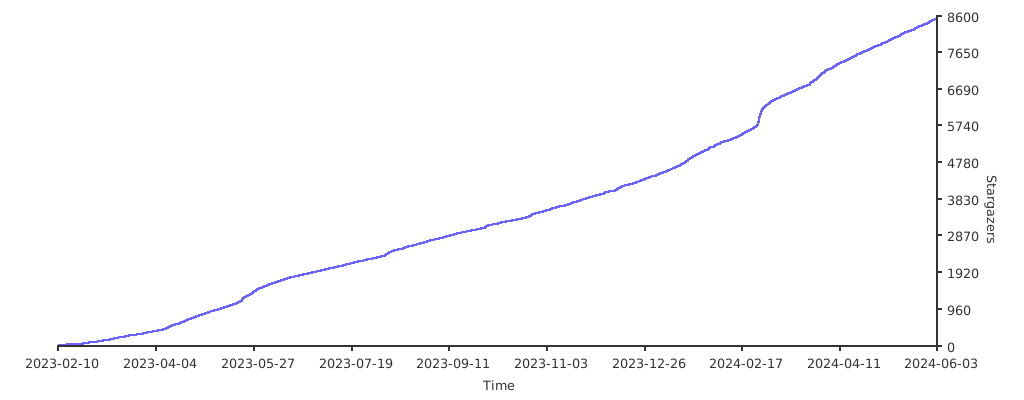
Stargazers over Time